Website Search Visibility Grows Through Connected Answers
Website Search Visibility Grows Through Connected Answers

Website search visibility exists when useful pages appear for the questions, comparisons, and decisions an audience genuinely makes. One impressive position for a broad term can look encouraging while producing little business value. Website search visibility is stronger when relevant pages earn discovery across an entire set of meaningful searches.
Improving rankings across relevant queries requires understanding why people search, not merely collecting phrases. Strengthening pages with topical depth gives each page enough substance to satisfy its purpose. Building internal links between related content helps visitors and crawlers follow the subject, while increasing qualified organic traffic connects discovery with useful action.
Organize visibility by the job of the query
Useful website search visibility covers different stages without forcing them onto one page. A query portfolio can be reviewed through four practical groups:UnderstandDefinitions, explanations, common problems, and introductory questions.EvaluateComparisons, alternatives, requirements, costs, examples, and proof.ActService, product, location, booking, purchase, or inquiry searches.ContinueSupport, maintenance, updates, advanced use, and related needs.
Improving rankings across relevant queries means choosing a suitable page for each job. Strengthening pages with topical depth helps those pages answer complete questions. Building internal links between related content connects the jobs into a coherent journey, and increasing qualified organic traffic depends on serving the people behind each query rather than maximizing impressions alone.
Start with query families, not isolated keywords

Byte Sized Template from Strikingly
A query family is a group of searches that share a subject and intent. Someone researching commercial photography might search for pricing factors, usage rights, preparation, portfolio examples, local availability, or a quote. These searches belong together, but they do not necessarily belong on one page.
Improving rankings across relevant queries begins by mapping each family to the page best able to answer it. For website search visibility, a service page can explain the offer and fit, a guide can answer preparation questions, a project example can show proof, and an FAQ can resolve recurring concerns. This prevents several weak pages from competing to provide the same answer.
Use current customer language from sales conversations, site search, support messages, and search performance data. The Strikingly guide to improving search engine ranking recommends descriptive titles, relevant content, headings, image descriptions, and analytics. Improving rankings across relevant queries still depends on usefulness and relevance rather than repetition.
Check whether the searcher expects information, a comparison, or an action. A page can mention related intents without trying to satisfy all of them. Website search visibility becomes clearer when every page has one primary job, a distinct title, and an obvious next place for readers who need more detail.
Do not publish another URL for every query variation. Merge variants when the same answer satisfies them. Separate pages only when the searcher's need, evidence, or action meaningfully changes. Improving rankings across relevant queries is easier when each indexed page has a defensible role.
Strengthen pages with topical depth
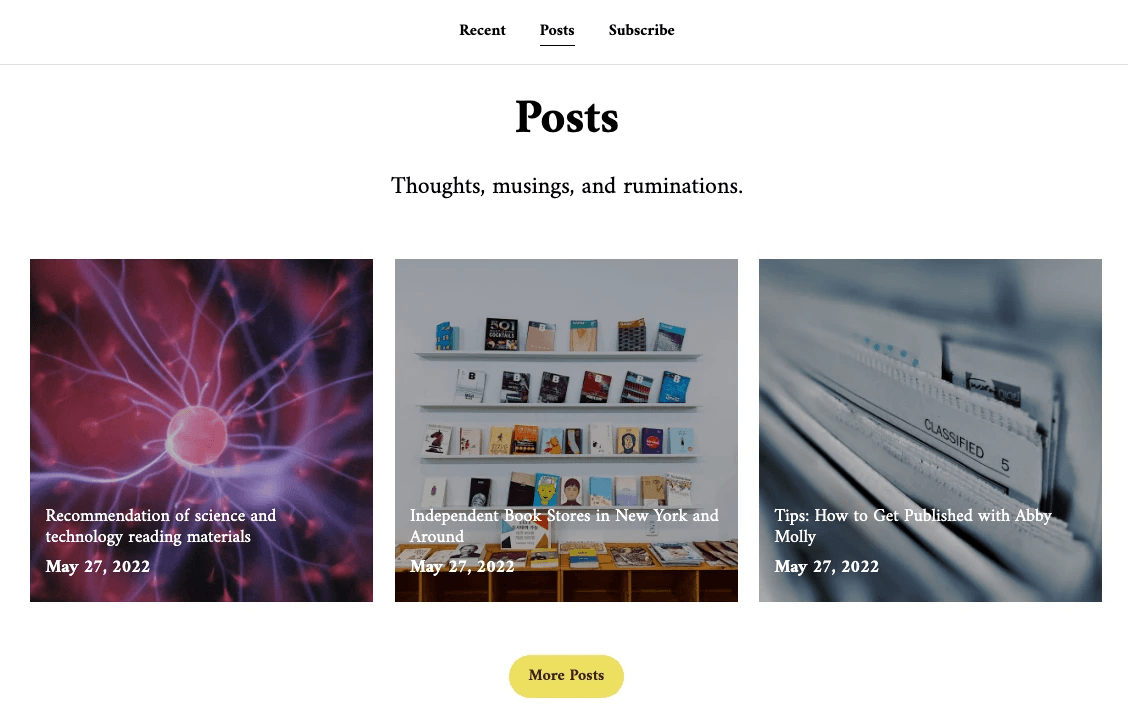
Book Store Blog Template from Strikingly
Strengthening pages with topical depth does not mean adding paragraphs until an arbitrary word count is reached. Depth comes from answering the important parts of a question with appropriate evidence. A complete service page may cover audience fit, process, options, limitations, outcomes, proof, FAQs, and the next step. A guide may need examples, definitions, exceptions, and links to primary sources.
Begin with the promise made by the title and opening. List the questions a reader must resolve to consider it fulfilled. Improving rankings across relevant queries and strengthening pages with topical depth then become editorial work: remove tangents, expand missing explanations, replace unsupported claims, and add evidence where a decision requires confidence.
The Strikingly blog SEO guide recommends valuable, readable, media-rich, and semantically complete material. Strengthening pages with topical depth supports website search visibility because quality is visible in how well a person can understand and use the page, not in how many terms appear.
Depth also exists across a group of pages. One pillar can explain the broad subject while focused pages handle specific problems or decisions. Strikingly's guide to SEO content clusters describes parent topics, subtopics, internal links, and updates. Strengthening pages with topical depth should improve the individual answer and its surrounding topic group. That architecture also supports website search visibility.
Build internal links between related content

Ink Blog Template from Strikingly
Building internal links between related content should help a reader continue the same line of thought. A beginner guide can link to an implementation checklist. A comparison can link to proof. A service page can link to a relevant project, and that project can return to the service. Every link should answer a likely next question.
Use descriptive anchor text that identifies the destination. The official linking guide explains how links can be added to text, images, buttons, and navigation. Building internal links between related content is most useful when the clickable words make sense before the visitor selects them.
Give important pages more than one sensible discovery route. A pillar page may be linked from navigation, related articles, and supporting guides, but that does not justify placing the link everywhere. Building internal links between related content requires relevance, not volume. Too many unrelated choices weaken the reading path.
Review links whenever pages are merged, renamed, or retired. Replace broken destinations, update outdated anchor text, and remove links that no longer help. Website search visibility suffers when valuable pages become isolated or visitors repeatedly reach obsolete information.
Use the Site Search feature as a recovery path for larger sites, not as a substitute for structure. Building internal links between related content should still make the next relevant page apparent to someone who does not know its title.
Make related reading selective and useful

Personal Blog Template from Strikingly
A related-content section can extend a topic, but automatic similarity is not enough. Choose links because they help the reader advance, compare, verify, or act. Building internal links between related content is stronger when every suggestion has a clear reason for appearing.
Explain each relationship with a specific label. "Next: compare implementation options" is more informative than "Related posts." Strengthening pages with topical depth includes offering supporting material without forcing every explanation into one page. Check both directions: a new article should link to its main topic, and the established page should link back when the addition fills a genuine gap. Building internal links between related content this way prevents orphan pages.
Confirm that useful pages can be discovered

Strikingly Responsive Website
Content cannot perform if it is hidden from indexing or absent from the site's paths. Building internal links between related content gives useful pages a route from established sections. The Strikingly guide to Google Search Console and sitemap submission covers verification and sitemap updates. Its guide for a site missing from Google lists indexing, privacy, password, forwarding, and submission checks.
Give each indexable page a unique, accurate search promise. The SEO title and meta description guide explains page-level settings and advises against duplicate descriptions. Improving rankings across relevant queries begins with a result snippet that matches the page rather than attracting the wrong click.
Improving rankings across relevant queries is useful only when pages satisfy the resulting visits. Strengthening pages with topical depth must include a clear opening, readable mobile layout, and accessible answer. Increasing qualified organic traffic depends on that transition from search result to useful experience.
Measure qualified organic progress
Increasing qualified organic traffic requires more than watching total sessions rise. Review impressions, clicks, landing pages, query intent, engaged reading, related-page movement, inquiries, purchases, or other outcomes that fit the site. A smaller query family can be commercially valuable when it consistently brings people with the right need.
Use built-in analytics and Google Analytics 4 to review landing-page behavior and traffic sources. Combine those signals with Search Console query data and business outcomes. Increasing qualified organic traffic is visible when relevant visitors understand, continue, and act.
Read performance by query family and page role. Informational pages may introduce the topic, comparison pages may deepen evaluation, and action pages may produce the conversion. Improving rankings across relevant queries and increasing qualified organic traffic should strengthen this sequence rather than judge every page by the same final action.
A monthly visibility review
Choose one topic family and compare its impressions with the page's intended job. For strengthening pages with topical depth, add one missing explanation. For increasing qualified organic traffic, repair one useful internal link and verify a meaningful downstream action. Record the change and allow enough time for a useful comparison.
Increasing qualified organic traffic can reveal content gaps. If visitors repeatedly enter through a beginner guide but never reach evaluation pages, the next link or supporting answer may be missing. If an action page attracts broad informational searches, its title or topic scope may need clarification.
Website search visibility grows when pages work as a connected body of useful answers. Improving rankings across relevant queries gives the site broader, more appropriate discovery. Strengthening pages with topical depth earns attention after the click. Building internal links between related content supports continued learning, and increasing qualified organic traffic turns that connected experience into measurable value.
Start with one commercially relevant topic and map the questions around it. Assign each intent to the strongest page, improve the gaps, connect useful routes, and measure whether the right visitors continue. Increasing qualified organic traffic through that repeated process creates durable website search visibility without manufacturing pages for every wording variation.
