Website Content Conversion Begins With the Next Useful Step
Website Content Conversion Begins With the Next Useful Step

An article can attract the right reader, answer an important question, and still produce no meaningful next step. Website content conversion improves when it recognizes what the reader is ready to do next: compare a service, open a related guide, download a worksheet, or ask a focused question. Conversion begins with continuity, not a sudden sales pitch.
The work has four parts. Connecting articles with relevant services turns demonstrated need into a credible path. Adding contextual calls to action fits each invitation to the surrounding idea. Guiding readers toward useful resources supports people who need more evidence. Measuring leads generated through content distinguishes qualified interest from empty clicks.
The five-question reader handoff test
- What specific question brought the reader to this article?
- What can the reader now complete independently?
- Which reasonable question remains?
- Which service or resource answers it with the least friction?
- Which event proves a qualified reader continued?
Use those questions before changing button colors or adding another form. Website content conversion is a path-design problem first. Connecting articles with relevant services, guiding readers toward useful resources, and measuring leads generated through content all depend on a clear reason for the transition.
Decision point one: the article has proved the problem matters

Marla Template from Strikingly
A service link belongs where readers recognize that the issue may require expertise or implementation support. Connecting articles with relevant services works after the article explains the problem and offers useful guidance. An early consultation link makes the content feel like an advertisement that happens to rank.
Define the relationship in one sentence: “This article helps readers diagnose X; the service helps them implement Y.” If it is weak, do not force the link. Website content conversion improves when the offer continues the same job with more support. The Strikingly article on content-driven conversions likewise recommends aligning useful content with an offer.
Connecting articles with relevant services also requires the right destination. Link to the specific service page, not a homepage that restarts the search, and use anchor text that names the value. Strikingly's linking guide covers text, image, and button links, while its section-link guidance can shorten a route through a long page.
Do not send every article to the same service. A beginner guide may lead to an assessment, a comparison to a scoped consultation, and a tutorial to implementation help. Connecting articles with relevant services should preserve context. This precision improves website content conversion by making the destination feel like the next chapter rather than a different conversation.
Decision point two: the reader is ready for an invitation
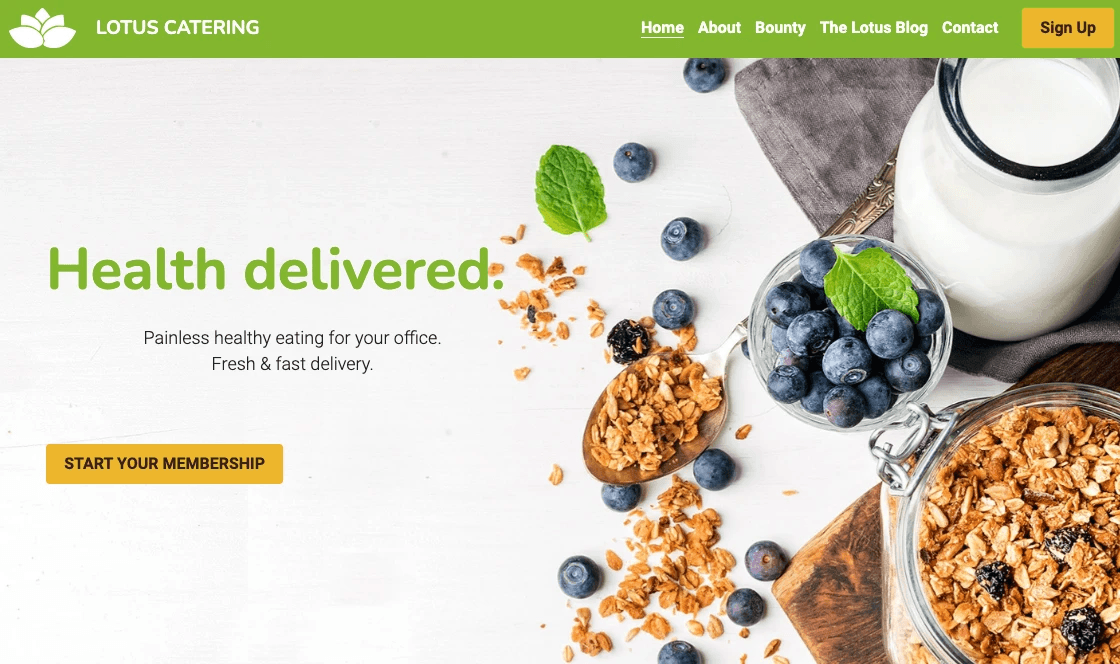
Lotus Template with CTA from Strikingly
Adding contextual calls to action means responding to the section immediately above. A checklist can offer a downloadable version, a diagnostic explanation an assessment, and a service example a conversation about fit. The CTA earns attention by naming the benefit that follows.
Use a short three-part formula: action, outcome, expectation. “Request a content-path review” names the action and outcome; nearby text can explain what the reader submits and what arrives next. Adding contextual calls to action is stronger than repeating “Contact us” because it reduces uncertainty. It also supports website content conversion without making every paragraph sound promotional.
Commitment should match readiness. An early reader may choose “See the service process,” while someone studying implementation may choose “Discuss my content library.” Adding contextual calls to action at two meaningful depths serves both without competing buttons: the first supports exploration, the later inquiry.
Keep the promise consistent after the click. A “Download the planning worksheet” CTA should not lead to a generic newsletter pitch, and “Review service options” should reveal those options immediately. Adding contextual calls to action includes preserving context through the destination, form, confirmation, and follow-up.
Visual emphasis should reflect importance, not urgency theatre. One clear button may deserve contrast; related reading can remain a text link. The Strikingly guide to a conversion-focused blog layout discusses inline CTAs and read-next recommendations. Adding contextual calls to action selectively protects reading comfort.
Decision point three: the reader needs another useful resource

Slow Drip Atelier Template from Strikingly
Not every informed reader is ready to inquire. Guiding readers toward useful resources respects that difference. A comparison, case study, calculator, checklist, glossary, or advanced guide can answer the next real question. The resource contributes to conversion when it deepens qualified interest.
Map resources by question rather than date. “What is this?” can lead to a beginner guide, “Which option fits?” to a comparison, and “Can this work for a business like mine?” to a case study. Guiding readers toward useful resources becomes easier when each asset has one reader job.
Strikingly's Simple Blog categories can group related articles, and Site Search helps visitors find pages, posts, and products directly. Guiding readers toward useful resources should still use curated links inside the article; search and categories provide a fallback for readers whose next question differs from the expected route.
Decide whether a resource should be open or gated. Open material builds trust around common questions; a form makes sense when the download is substantial and follow-up can genuinely help. Guiding readers toward useful resources should never make a simple answer conditional on contact details.
Decision point four: the reader chooses to identify themselves
A form is a value exchange, not merely a capture mechanism. Ask only for information needed to deliver the promised resource or respond well. Strikingly's Custom Form supports multiple field types, and its guide to connecting forms with external services explains how submissions can enter a follow-up workflow. Adding contextual calls to action should prepare readers for that form before it appears.
Label the expected response: an immediate file, personal email, scheduling link, or review within a stated period. Connecting articles with relevant services is more credible when the inquiry process is visible. Guiding readers toward useful resources is more trustworthy when delivery and description match.
Use Audience contact management to preserve source context and Audience emails for relevant follow-up. Website content conversion should not drop every lead into the same sequence. Guiding readers toward useful resources requires a different response from a request for service scope.
Measure the handoff, not only the final form

Strikingly GA4 Measurement Setup
Measuring leads generated through content begins with a path: article view, meaningful CTA click, destination view, form start, submission, and qualified outcome. Counting submissions alone hides where readers hesitate. It also hides articles that create valuable assisted journeys without being the final page before conversion.
Strikingly's event-tracking guide notes that button clicks and form submissions can be tracked, while the GA4 integration guide explains connecting a measurement ID. Measuring leads generated through content becomes practical when CTA and submission events are tied to the article and offer that produced them.
Review quality as well as volume. Measuring leads generated through content should include qualified-lead rate, response rate, time to conversation, and eventual revenue where the sales cycle permits. An article producing five relevant inquiries may be more valuable than one producing fifty unrelated downloads. Connecting articles with relevant services should improve fit, not simply increase activity.
Compare CTA positions and promises one change at a time. Adding contextual calls to action can be tested through wording, location, and destination, but changing all three together weakens the lesson. Measuring leads generated through content should reveal why a handoff worked, while guiding readers toward useful resources can be evaluated through onward clicks. Use built-in analytics for a broad page view and GA4 for deeper event paths.
Run a monthly content-to-lead review
Select one high-traffic article, one high-intent article, and one article that receives qualified inquiries. For each, review connecting articles with relevant services, adding contextual calls to action, guiding readers toward useful resources, and measuring leads generated through content. This keeps website content conversion grounded in different reader situations instead of copying the same CTA into every post.
- Before guiding readers toward useful resources, fully answer the article's primary question.
- Verify that connecting articles with relevant services continues the article's exact promise.
- When adding contextual calls to action, remove competitors at the same decision point.
- Test the form and confirmation on both desktop and mobile.
- Record one change and how measuring leads generated through content will determine whether it helped.
The Strikingly blog optimization guide emphasizes quality, relevance, readability, and complete coverage. Those standards support website content conversion because useful content earns the trust that a next step depends on. Measuring leads generated through content then shows whether that trust continued into action.
Make the next step feel earned
Website content conversion does not require turning every article into a landing page. It requires recognizing the reader's next question and providing an honest route forward. Connecting articles with relevant services works when the service extends the solution. Adding contextual calls to action works when the invitation responds to the nearby idea.
Guiding readers toward useful resources gives undecided visitors room to learn, while measuring leads generated through content shows which routes deserve improvement. Begin with one article that already attracts the right audience. Clarify its reader job, choose one primary continuation, explain what happens after the click, and measure the complete handoff. Repeat the practice only after the first path makes sense.
