Website Business Credibility Should Survive a Five-Minute Check
Website Business Credibility Should Survive a Five-Minute Check

A polished site can impress, but a prospect still verifies the business. Who operates it? Has the team solved a comparable problem? Do customers confirm the outcome? Can a visitor ask a question? Website business credibility grows when those checks produce consistent answers.
Four evidence types work together. Showing detailed company information establishes identity and context. Highlighting relevant industry experience demonstrates applicable capability. Displaying customer success evidence supports claims, while providing transparent contact information makes the company accountable and reachable.
The five-minute credibility file
- Identity: Find the business name, purpose, location or service area, ownership context, and current offer.
- Capability: Locate relevant projects, methods, qualifications, publications, or years of focused practice.
- Customer evidence: Confirm who achieved what result, under which conditions, and over what period.
- Accountability: Test the contact route, response expectation, policy links, and responsible business details.
- Consistency: Compare names, claims, dates, and contact details across important pages and public profiles.
Run this check while signed out and on a phone. Do not rely on knowledge that only employees possess. The exercise turns website business credibility into verifiable information rather than a design opinion. Strikingly's guide to a website credibility strategy built on verifiable details similarly places evidence beside the claim and risk it addresses.
Minute one confirms who the visitor is dealing with

Sleek Template from Strikingly
Showing detailed company information begins with the legal or trading name, a plain description of the business, the audience served, core offers, location or service area, and operating availability. Depending on the decision, visitors may also need leadership names, ownership context, pricing cues, delivery limits, cancellation terms, or a physical address. Showing detailed company information should also distinguish a registered entity from a public-facing brand when their names differ.
Put identity on the About page, but do not hide it there. Showing detailed company information means the homepage, service pages, footer, contact page, directory listings, and social profiles do not contradict one another. For showing detailed company information consistently, maintain one approved record for names, addresses, hours, and service boundaries. A visitor should not find three spellings of the company name or two different phone numbers.
Specificity matters more than corporate volume. Showing detailed company information does not require a long history full of slogans. State what the company does now, where it works, who is responsible, and what a customer should expect. The Strikingly article on business website design that supports trust explains why visual polish should help visitors understand the company rather than substitute for proof.
Assign an owner and review date to facts that can expire. Website business credibility weakens when an old staff biography, retired service, obsolete office address, or expired policy remains visible. A canonical company record makes showing detailed company information easier to maintain across every page. Showing detailed company information is therefore a maintenance practice as well as a writing task.
Minute two tests whether experience fits the current claim

Social Proof on Strikingly Landing Page
Highlighting relevant industry experience means selecting work that helps this visitor judge this offer. Ten years in business may be reassuring, but a comparable project, documented process, specialized role, or industry problem is more useful. For highlighting relevant industry experience, state the role the business actually performed. Experience becomes credible when its relevance is explained.
Use portfolios and project summaries to show the setting, challenge, contribution, and result. Highlighting relevant industry experience should reveal decisions and constraints, not only attractive finished images. Highlighting relevant industry experience also means separating team capability from one former employee's work. If confidentiality limits details, describe an approved industry, scope, method, or range rather than inventing a vague success claim.
Qualifications need scope. Highlighting relevant industry experience may include licenses, certifications, association memberships, awards, publications, partnerships, or training, but each item should state who holds it, what it covers, who issued it, and whether it is current. Highlighting relevant industry experience should never imply broader coverage than the source supports. A course badge should not look like regulatory approval.
Place experience where it answers risk. Highlighting relevant industry experience on a technical service page may require a relevant credential and implementation example. On a strategy page, a published method and comparable case may matter more. Website business credibility improves when proof is selected for the decision instead of repeated as a decorative logo row.
Apply the source-scope-date test
- Source: Can the visitor identify who issued, measured, or confirmed the evidence?
- Scope: Is it clear which person, service, location, product, or process the evidence covers?
- Date: Can the visitor tell whether the proof is current enough for the claim?
Minute three asks customers to support the promise
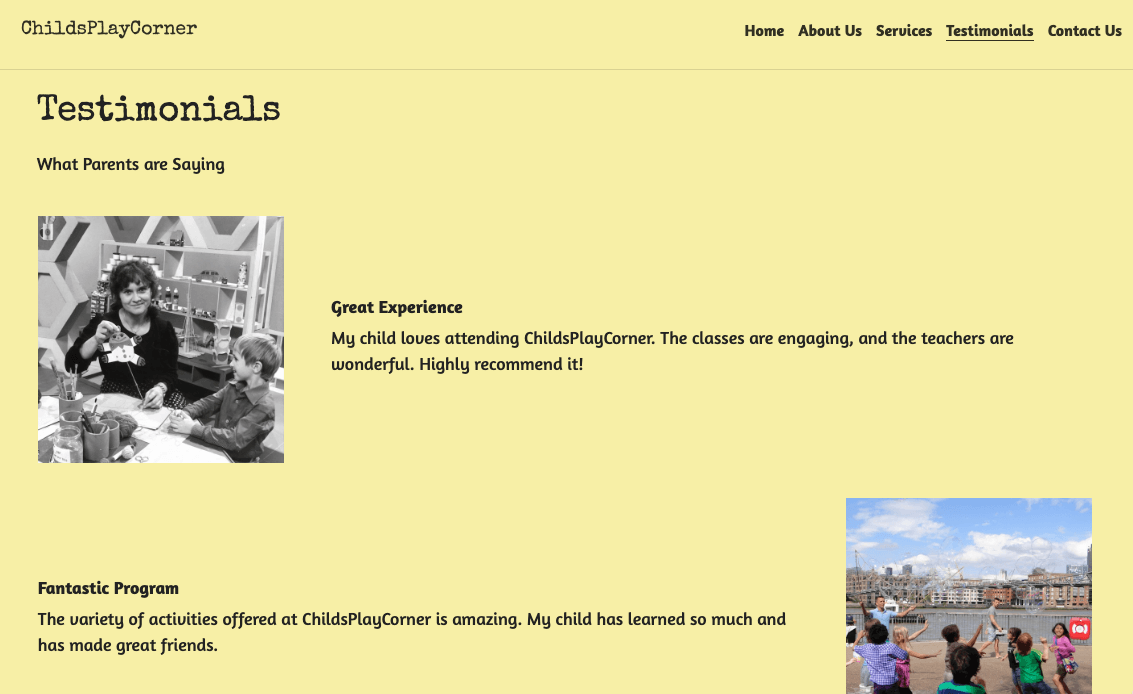
Kid Class Template from Strikingly
Displaying customer success evidence begins with context. A strong testimonial or case study identifies the customer's situation, the problem, the work, and the observed change. For displaying customer success evidence responsibly, note conditions that materially shaped the result. “Excellent service” communicates approval, but it does not help a prospect decide whether the business can solve a comparable problem.
Keep the original feedback, approved edit, attribution, consent, date, and intended placement together. Displaying customer success evidence should never rely on an invented identity or a result the customer did not confirm. Strikingly's article on website customer testimonials as verifiable evidence emphasizes authentic feedback, understandable outcomes, and appropriate permission.
Numbers need a baseline, period, and definition. Displaying customer success evidence such as “inquiries rose 30 percent” should identify the comparison period and what counted as an inquiry. Displaying customer success evidence should also name whether the source is analytics, customer records, or an estimate. Mention other important factors when they affected the outcome. Modest attribution protects website business credibility better than an absolute claim the evidence cannot establish.
Match proof to the nearby question. Displaying customer success evidence beside a service claim lets the visitor test that claim immediately. A delivery concern needs evidence about timing; an adoption concern needs a story about training and use. The Strikingly guide to customer success stories shows how detailed cases can document context, choices, measurable outcomes, and limitations.
Use more than one customer condition over time. Displaying customer success evidence only from an exceptional project can distort expectations. A credible proof library covers different needs, constraints, and outcomes while making clear that individual results vary.
Minute four verifies that a real response is possible

Hair Salon Template from Strikingly
Providing transparent contact information means showing the channels the business actually monitors: phone, email, form, address, service area, opening hours, or appointment route as relevant. Providing transparent contact information also means naming different routes for sales, support, privacy, or urgent issues when needed. State expected response timing and what happens after submission. A form labeled “Get in touch” without any expectation transfers uncertainty to the visitor.
Use Strikingly's contact or signup form for a simple route and a Custom Form only when extra details improve the response. For providing transparent contact information, explain which fields are required and why. Providing transparent contact information should not require collecting unnecessary personal data before someone can ask a basic question.
Test every route. Providing transparent contact information includes calling the number, opening the email link, submitting the form, checking the confirmation, and verifying the mapped location. Providing transparent contact information also requires an owner who notices failed delivery. Run the same test on mobile. Website business credibility disappears quickly when the most important contact method fails silently.
The footer is a recovery point. Providing transparent contact information there can include an address or service area, phone or email, hours, contact link, and relevant policies. Strikingly's footer editing guide covers footer content, while its guide to adding terms or a privacy policy supports clear policy access.
Minute five checks whether the evidence agrees
Website business credibility depends on consistency across the full decision route. Showing detailed company information on the About page is not enough if the contact page uses an old address. Highlighting relevant industry experience is not enough if credentials lack dates or scope. Displaying customer success evidence is not enough if the linked service no longer exists. Every contradiction reduces website business credibility.
Review the homepage, major service pages, About page, proof pages, contact page, footer, forms, policy links, directory listings, and active social profiles as one system. Providing transparent contact information should produce the same identity everywhere. The Strikingly article on business website footers recommends testing contact, social, navigation, policy, and ownership details rather than treating the footer as decoration.
Assign one owner to each expiring fact or proof item. Website business credibility is easier to maintain when credentials have renewal dates, customer permissions have records, case results have sources, and contact details have a canonical location. A quarterly verification check can catch contradictions before a prospect does.
Measure inquiry quality and direct feedback after credibility improvements. More submissions may indicate stronger confidence, but better questions, fewer requests for basic verification, and more appropriate prospects often provide stronger evidence. Use Strikingly's built-in analytics for page patterns while remembering that credibility itself is not a single dashboard number.
Website business credibility is the result of inspectable details, relevant capability, grounded customer proof, and reachable people. Keep showing detailed company information where identity matters, highlighting relevant industry experience where expertise changes the decision, displaying customer success evidence beside important claims, and providing transparent contact information wherever a visitor may need accountability. Website business credibility follows when the evidence survives scrutiny.
