Service Business Website Content That Helps Clients Judge Fit
Service Business Website Content That Helps Clients Judge Fit

A prospective client cannot inspect a service before buying it. They judge the offer through explanations, boundaries, proof, and the quality of the next step. Strong service business website content gives them enough evidence to decide whether a conversation is worthwhile without pretending that every project is identical.
That evidence should arrive in the order people need it. Explaining service packages clearly establishes what is available. Answering common customer concerns reduces avoidable uncertainty. Showing examples of completed work demonstrates how promises become deliverables, while highlighting measurable service outcomes shows why the work mattered. Service business website content then becomes a useful pre-project briefing instead of a collection of broad claims.
Build one decision file, not five disconnected sales blocks

Yoga Template from Strikingly
The clearest service business website content answers five questions in a deliberate sequence, giving every section a defined job in the client's evaluation:
- Fit: Who is the service designed for, and what situation does it address?
- Scope: What is included, excluded, delivered, and expected from the client?
- Risk: What usually causes hesitation, and what honest information resolves it?
- Proof: Which completed project resembles the reader's problem?
- Outcome: What changed, how was it measured, and what should the reader do next?
This order connects explaining service packages clearly with answering common customer concerns before a visitor reaches the inquiry form. It also gives showing examples of completed work and highlighting measurable service outcomes a specific role. Each proof point answers a question raised by the scope rather than interrupting the page as decoration.
Begin with one representative service. Record its audience, triggering problem, deliverables, timing, dependencies, strongest example, and most defensible result. The Strikingly guide to service website optimization similarly connects advantages, proof, and decision support.
Describe a package as an agreement about scope

Strikingly Pricing Table
In service business website content, names such as Starter, Growth, and Premium are not self-explanatory. Explaining service packages clearly means translating each label into a recognizable situation. State who the package suits, its principal deliverables, expected timeline, review allowance, and exclusions. A reader should be able to reject an unsuitable option without contacting the business first.
Explaining service packages clearly requires parallel information so options can be compared fairly. If one package lists deliverables while another describes benefits, the difference remains hard to judge. A Strikingly Pricing Table section can align options, but explaining service packages clearly still depends on meaningful copy. Replace “full support” with the channel, response window, meeting allowance, and end date that define support.
Pricing can be exact, a starting figure, a typical range, or an explanation of quote factors. Explaining service packages clearly also means stating when discovery may change the scope. A migration package might cover fifty pages but require a separate estimate for custom integrations. That boundary protects both parties.
Match the call to action to the offer. A fixed package may lead to a booking; variable work may require a scoped consultation. Strikingly's Bookings section can present availability, while a Custom Form can collect qualification details. Explaining service packages clearly includes saying what happens after either action.
Resolve concerns where commitment increases
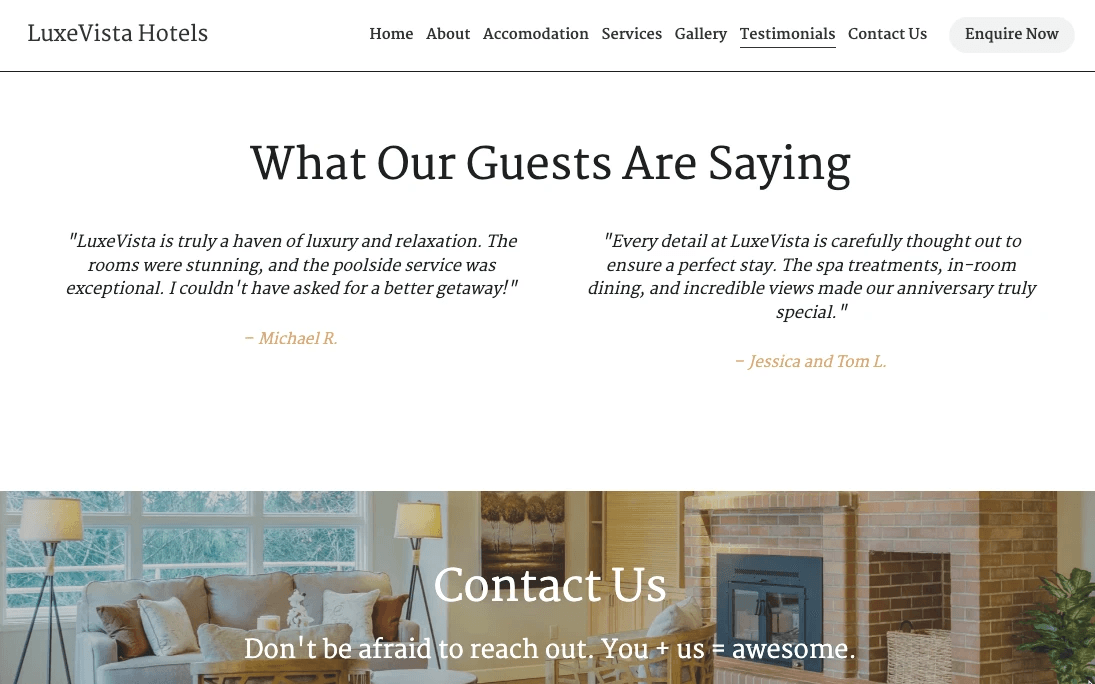
Hotel template from Strikingly
Service business website content should not hide every difficult question in a distant FAQ. Answering common customer concerns works best beside the claim or action that creates the concern. Put scheduling expectations near the timeline, data handling near the form, revision limits near deliverables, and cancellation terms near booking.
Start answering common customer concerns with evidence from sales emails, support messages, proposal questions, and reasons prospects decline. Group them by uncertainty: fit, cost, effort, risk, timing, access, or accountability. The article on customer-focused website content shows why objections should shape a page before the visitor is asked to act.
Answer directly, then add a boundary. “Most projects take four to six weeks after materials are approved” is more credible than “fast turnaround.” Answering common customer concerns requires naming who supplies inputs, who approves stages, and what can delay delivery. That specificity makes answering common customer concerns credible without pretending problems never occur.
Testimonials help with answering common customer concerns when they contain detail. A quote about communication belongs near the process; a quote about adoption belongs near onboarding. Generic praise cannot replace policy. A contact form should also explain expected response time instead of leaving the prospect to guess.
Let a completed project reveal judgment

Sleek Template from Strikingly
In service business website content, showing examples of completed work should help a prospect compare their situation with a past engagement. Choose examples by problem, service, constraint, or outcome. A screenshot without context proves that something existed, but not what the provider contributed.
Give each example a compact evidence chain: starting condition, constraint, chosen approach, concrete deliverable, result, and proof source. If confidentiality prevents naming a client, identify the sector and scale, remove sensitive details, and explain the permission limits. The guide to building a business portfolio website recommends treating project cards, detail pages, case studies, and proof sources as different levels of depth.
Showing examples of completed work also requires explaining tradeoffs. A consultant may have selected a simpler reporting system because the client needed adoption more than customization. A designer may have retained familiar navigation because testing showed that novelty caused confusion. Showing examples of completed work reveals expertise when those decisions are included.
Use consistent fields across examples so visitors can scan for relevance. The Portfolio and Product Showcase supports descriptions, multiple images, and categories. Showing examples of completed work is useful when each item includes the service, client situation, delivery period, and outcome.
Make outcome claims inspectable
Highlighting measurable service outcomes begins with the original condition. “Reduced response time” means little without the earlier response time, later result, measurement period, and changed process. When highlighting measurable service outcomes, a defensible claim might say that median first response fell from two business days to six hours during the eight weeks after a support workflow was introduced.
For service business website content, choose measures that match the work. Revenue is not the only credible result. Completion rate, hours saved, error reduction, adoption, qualified inquiries, or satisfaction may be closer to the service. Highlighting measurable service outcomes means labeling estimates, ranges, client-reported figures, and observed trends accurately instead of inventing precision.
Explain the source in one sentence. Strikingly Built-in Analytics can support traffic observations, while Google Analytics 4 can support event analysis. Operational evidence may come from a CRM, survey, booking system, or client records. Highlighting measurable service outcomes becomes believable when readers can see what was counted.
Connect each result to the action that plausibly influenced it, and avoid claiming sole credit for work shared with the client or other vendors. Showing examples of completed work gives the result a story; highlighting measurable service outcomes gives that story a test. Together they help a buyer distinguish a relevant capability from an attractive but unsupported claim.
Run a proposal-readiness review
Before publishing, read the page as though it were the first page of a proposal. Strong service business website content should make the following review possible without a sales representative translating it:
- Confirm that explaining service packages clearly includes audience, deliverables, timing, responsibilities, exclusions, and a suitable next step.
- Check that answering common customer concerns uses specific policies, process details, or evidence instead of vague reassurance.
- Verify that showing examples of completed work explains the problem, constraint, decision, deliverable, and permission status.
- Ensure that highlighting measurable service outcomes names a baseline, result, period, source, and reasonable limitation.
- Follow every link, test every form, and view the page on a phone before asking prospects to rely on it.
Ask someone outside the delivery team to summarize the offer after one reading. Answering common customer concerns should survive this test: if they cannot explain fit, package differences, or why the examples matter, revise the page. The Strikingly article on service presentation offers further guidance.
Then compare the page with actual inquiry quality. Service business website content is working when prospects arrive with realistic expectations and relevant questions. Explaining service packages clearly may reduce requests outside scope. Answering common customer concerns may improve form completion. Showing examples of completed work may change which service people ask about, while highlighting measurable service outcomes may increase references to a particular case during calls.
Review the evidence quarterly and after meaningful service changes. Update package boundaries, recurring concerns, permissions, screenshots, metrics, and response expectations. Highlighting measurable service outcomes requires current evidence, so the page should reflect the service delivered now rather than the one described last year.
Give the next client evidence they can use
Effective service business website content does not pressure every visitor into immediate contact. It helps the right client recognize fit, understand the agreement, inspect relevant proof, and choose an appropriate conversation. That is why explaining service packages clearly and answering common customer concerns belong before the strongest call to action.
Select one important service page and build its decision file this week. Replace one vague package label, answer one recurring concern beside the relevant commitment, expand one project into a useful evidence chain, and qualify one outcome claim. Showing examples of completed work and highlighting measurable service outcomes will then support a decision instead of merely decorating the page.
