Protect Search Visibility With a Disciplined Website Redesign SEO Plan
Protect Search Visibility With a Disciplined Website Redesign SEO Plan

A redesign can improve clarity and still damage discovery if important URLs disappear, useful copy is replaced, or search engines receive conflicting signals. Website redesign SEO treats the move as a controlled migration. Design, content, development, and search decisions share one page-level record instead of being resolved after launch.
The work connects four responsibilities. Planning redirects before launch gives every changed URL a destination. Preserving valuable page rankings protects useful intent and evidence. Updating outdated metadata during redesign keeps search snippets accurate, while checking indexed pages after migration reveals what search engines actually accepted.
Give every old URL a migration record
- Current asset: Record the URL, purpose, intent, metadata, internal links, traffic, conversions, and important backlinks.
- Decision: Choose keep, improve, merge, redirect, or intentionally remove; do not leave the outcome blank.
- Destination: Name the final URL and confirm that it satisfies the old page's most useful intent.
- Build requirements: List the copy, media, forms, metadata, analytics, accessibility, and mobile behavior to carry over.
- Release proof: Assign an owner, redirect test, content approval, launch status, and post-launch index check.
This register is the control surface for website redesign SEO. Begin with URLs found in the sitemap, analytics, search reports, navigation, known backlinks, campaign records, and server or crawl data. The Strikingly article on rehearsing website content migration recommends an inventory broad enough to include pages outside the main menu.
Record the baseline before editing. Preserving valuable page rankings is impossible to evaluate if the team cannot identify existing queries, landing traffic, links, conversions, and page purpose. Rankings can change for many reasons, so the goal is not a guarantee. Website redesign SEO uses the record to give later investigation a credible starting point.
Start preserving valuable page rankings with meaning

Strikingly SEO Checklist
Preserving valuable page rankings begins with understanding why the page deserves visibility. Identify the question, audience, useful sections, supporting proof, internal relationships, and next action. Preserving valuable page rankings means making those strengths easier to use rather than replacing them with a less informative page.
For preserving valuable page rankings, keep the URL stable when the page still serves the same purpose. Avoid changing the URL, search intent, main copy, navigation position, and page design simultaneously unless the business case requires it. Fewer concurrent variables make a drop easier to diagnose. Strikingly's guide to refreshing strong website content similarly recommends retaining useful explanations and relationships.
Decide page outcomes with evidence, not age. A dated page may still attract qualified visitors and answer an important question. If several weak pages are merged, the new destination must genuinely cover their combined intent.
Preserving valuable page rankings also depends on internal discovery. Update navigation, contextual links, buttons, categories, and footers so they point directly to final destinations. Website redesign SEO should not rely on redirects to repair links the redesign controls. Website redesign SEO uses direct paths to clarify the new structure.
Make planning redirects before launch a release requirement
Strikingly "Page Not Found" Page
Planning redirects before launch means assigning every changed old URL one relevant, live destination. Planning redirects before launch belongs inside page approval, not the final publishing hour. The closest useful page is normally better than the homepage because it continues the original task.
Use permanent redirects for permanent moves and point each old address directly to its final destination. Planning redirects before launch should prevent chains, loops, soft 404s, redirects to unpublished pages, and blanket homepage routing. Strikingly's article on the 301 redirect process highlights relevant destinations, direct paths, case sensitivity, trailing slashes, and thorough testing.
Confirm what the existing host, new host, domain provider, proxy, and plan can support before approving changed paths. Planning redirects before launch may require preserving an old slug when page-level routing is unavailable. Strikingly's guidance for permanent domain forwarding covers domain-level moves, but domain forwarding is not a substitute for an old-to-new page map.
Test the map in batches. Planning redirects before launch includes opening high-value old URLs, confirming one permanent hop, checking the final status, and verifying that the destination answers the original intent. Test capitalization, trailing slashes, file links, query strings, old subdomains, bookmarks, and backlinks that still send meaningful visits.
Keep the redirect register after release. Planning redirects before launch creates the expected result; logs and manual checks reveal exceptions. A rule can be configured correctly yet fail at the edge.
Treat updating outdated metadata during redesign as page work

Strikingly Mobile Website
Updating outdated metadata during redesign starts by carrying the current title, description, URL, heading, and intended query into the page record. Compare them with the approved new content. A title should identify the page accurately; a description should summarize the value a searcher will actually find.
Do not replace every established snippet simply because the visual design changed. Updating outdated metadata during redesign is useful when the offer, audience, terminology, location, proof, or page purpose changed. Keep accurate elements that still match search intent. Strikingly's guide to SEO titles and meta descriptions supports unique, descriptive page titles and page-specific descriptions.
For updating outdated metadata during redesign, flag duplicates, missing fields, retired products, obsolete dates, unsupported promises, and descriptions that no longer match visible copy. Updating outdated metadata during redesign should also cover social-sharing details, image alternatives, canonical choices, and headings. The Strikingly SEO guide connects titles and descriptions with useful content, image descriptions, domains, and analytics.
Preview every priority page on desktop and mobile while updating outdated metadata during redesign. Confirm the visible H1, browser title, search description, navigation label, and page purpose agree. Website redesign SEO becomes fragile when metadata promises one service and the redesigned page presents another.
Maintain a review state for updating outdated metadata during redesign: unchanged and approved, revised and approved, or blocked by unfinished content. This prevents placeholder titles and copied descriptions from reaching production. A complete page record should show who approved each search-facing field and when.
Website redesign SEO needs a launch gate that can stop publication
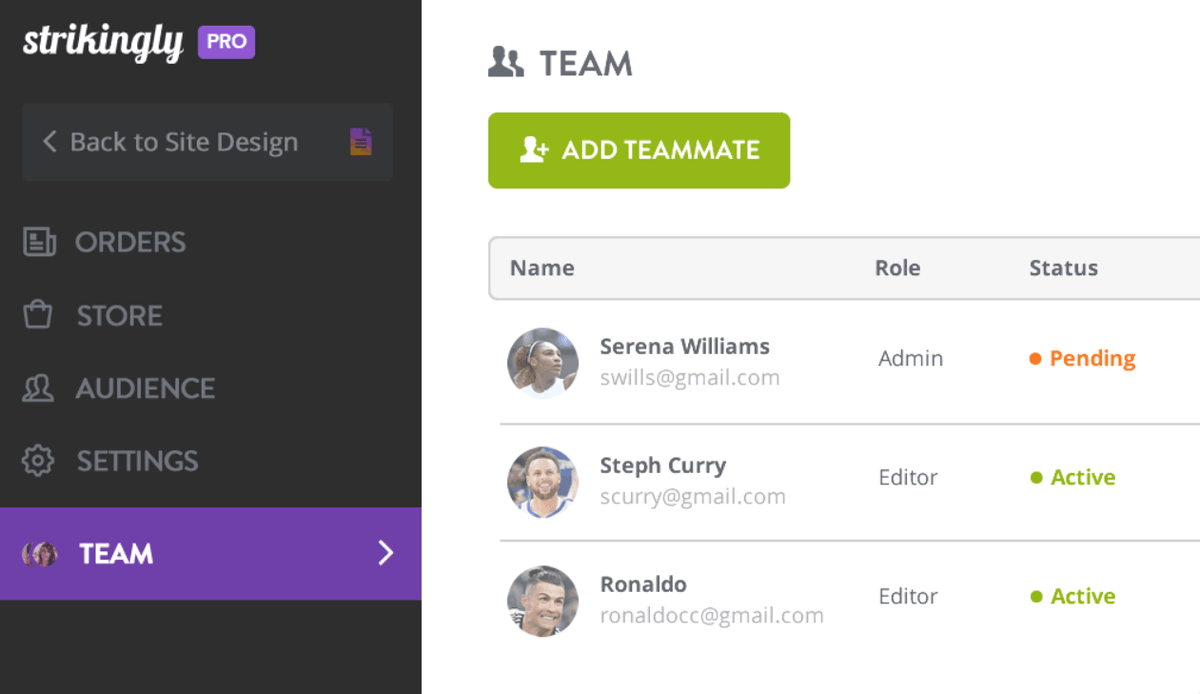
Strikingly Team Feature
A release owner should reconcile the migration register before publishing. Website redesign SEO is not ready when priority pages lack destinations, redirects remain untested, metadata is unapproved, or analytics cannot distinguish the release. Website redesign SEO should delay launch when a protected path still fails.
The final prelaunch gate
URLs: Every old address has an approved keep, redirect, merge, or removal decision.
Pages: Priority destinations are published in preview, substantial, internally linked, and usable on mobile.
Search signals: Titles, descriptions, headings, image alternatives, canonical choices, and crawl settings are approved.
Operations: Forms, purchases, downloads, tracking, policies, domains, and recovery steps have owners and test results.
Monitoring: The team has saved baselines and knows who checks redirects, indexing, traffic, and conversions after release.
Limit publication rights and record the release time. Planning redirects before launch should end with a final map and test owner. Preserving valuable page rankings should end with approved content evidence. Updating outdated metadata during redesign should end with page-level signoff, not a general assurance.
Reconcile the index after the migration
Checking indexed pages after migration begins with immediate technical checks. Checking indexed pages after migration requires a working domain, successful priority pages, final redirect targets, active analytics, and crawl access. Strikingly's publishing guide explains when saved changes become live and notes that custom-domain updates can take time to propagate.
For website redesign SEO, connect Google Search Console and submit the current sitemap. Checking indexed pages after migration means comparing submitted URLs, discovered pages, indexed pages, excluded pages, and errors rather than searching only for the homepage. The official Search Console and sitemap guide covers verification and resubmission when pages change.
Use URL Inspection for priority pages and representative examples from every template or page type. Checking indexed pages after migration should confirm the canonical URL, crawl allowance, latest crawl, rendered content, and index status. Requesting repeated crawls does not force immediate indexing, so record the request and check again on a realistic schedule.
For checking indexed pages after migration, compare the old inventory with the new sitemap and search coverage. Checking indexed pages after migration should confirm that old URLs redirect or return an intentional status and that new priority pages have internal links. Strikingly's guide for a site that does not appear in Google explains index checks, crawl requests, sitemaps, and common blocking conditions.
Watch search entrances, query groups, landing pages, conversions, and 404 activity by page type. Checking indexed pages after migration is more informative when paired with behavior: an indexed page can still underperform because its intent or conversion path changed. Use built-in analytics for traffic and page patterns, then investigate meaningful deviations from the saved baseline.
Keep a daily issue log during the first days and a weekly review through a complete business cycle. Checking indexed pages after migration may reveal delayed crawling, accidental exclusions, old snippets, redirect gaps, or content loss. Preserving valuable page rankings requires correcting the underlying page, path, or signal rather than repeatedly requesting indexing.
Website redesign SEO succeeds when the new experience is easier to use and the old site's earned value still has a clear route forward. Planning redirects before launch protects known addresses. Preserving valuable page rankings protects meaning. Updating outdated metadata during redesign aligns search expectations with the new page, and checking indexed pages after migration verifies the result in the real index.
