Online Business Branding Should Feel Familiar Everywhere
Online Business Branding Should Feel Familiar Everywhere

A customer rarely experiences a brand in one uninterrupted visit. They may notice a social post, open a service page days later, read a review, receive a confirmation, and finally return from an email. Online business branding works when those separate moments feel as though they came from the same clear-minded business.
That familiarity is not created by stamping a logo on every screen. Developing recognizable visual elements gives people reliable visual cues. Maintaining consistent brand messaging keeps the promise stable as the format changes. Strengthening customer brand recall helps the business remain identifiable later, while creating cohesive digital touchpoints prevents each channel from behaving like a separate company.
Run a five-minute recognition test
Before redesigning anything, place five customer-facing items side by side: a homepage screenshot, a social post, a sales email, a form confirmation, and a recent newsletter. Then review them without relying on the logo.
- Do colors, image treatment, typography, and layout suggest the same business?
- Do all five describe the same audience problem and value?
- Does the same action keep the same label across channels?
- Does the tone remain recognizable from promotion through support?
- Can a returning customer anticipate what the next link will provide?
This test makes online business branding observable. It reveals whether developing recognizable visual elements has produced a usable system, whether maintaining consistent brand messaging survives handoffs, and whether creating cohesive digital touchpoints is happening beyond the homepage. Each clear match also contributes to strengthening customer brand recall.
Choose visual cues that can survive real use

Brand Coach Template from Strikingly
For online business branding, developing recognizable visual elements starts with selection, not accumulation. Choose a primary logo, a simplified small-space mark, a restrained palette, a practical type hierarchy, and an image direction. Each cue must work on a wide page, phone, social thumbnail, and email header.
Write down usage rules. Define minimum logo space, approved color combinations, heading styles, button treatment, image crops, and situations where a simpler version is required. Strikingly's article on the importance of visual identity connects logos, color, typography, and imagery with recognition. The official Strikingly branding guidelines also provide a useful example of protecting logo proportions, color, spacing, and type.
Developing recognizable visual elements does not make every asset identical. A case study may use documentary photography while a launch uses a clean graphic. Shared framing, color, typography, and editorial judgment keep both familiar. Online business branding needs controlled range, not monotony.
Use the Strikingly Styles controls for site-wide fonts, button colors, backgrounds, and navigation. Follow the logo upload guide, then set a browser icon with the favicon instructions. Together, developing recognizable visual elements covers central and peripheral cues, while strengthening customer brand recall grows through both.
Give every writer the same message foundation

Scribble Template from Strikingly
In online business branding, maintaining consistent brand messaging begins with a short hierarchy. State who the business helps, the problem addressed, the outcome supported, the reason to believe it, and the next action. These points should guide a homepage, product description, support reply, or campaign without forcing identical copy.
Create a voice sheet with examples, not vague adjectives. "Helpful" means explaining terms. "Direct" means stating conditions without evasive language. "Confident" means supporting claims instead of adding superlatives. The Strikingly guide to business website messaging connects audience understanding, visual choices, trust, and consistent communication.
Maintaining consistent brand messaging does not mean repeating the homepage sentence everywhere. A social post may create curiosity, a service page may explain fit, and an onboarding email may reduce uncertainty. The information changes with the task, but the value, vocabulary, and attitude should remain compatible. This is central to creating cohesive digital touchpoints.
Maintaining consistent brand messaging is easier with an approved language library: business description, product names, proof, button labels, response expectations, and words to avoid. Review it when offers change; that discipline supports strengthening customer brand recall. Online business branding becomes fragile when one channel keeps an old promise.
Follow the promise through a touchpoint relay

AudiencePro Template from Strikingly
Creating cohesive digital touchpoints becomes practical when a team follows one customer path end to end. Trace a real route, such as advertisement to landing page to inquiry form to confirmation email to newsletter. At each handoff, identify the promise carried forward and the new assurance needed.
Check one route in five handoffs
- Discovery: confirm that the visual cue and core claim introduce the right expectation.
- Arrival: repeat the relevant promise so the visitor knows the click led to the correct place.
- Decision: use proof, terms, and action labels that match the offer already presented.
- Confirmation: preserve the voice while explaining what happens and when.
- Return: connect the next message to the customer's previous action instead of restarting the relationship.
Maintaining consistent brand messaging through this relay reduces uncertainty. Developing recognizable visual elements helps the customer orient quickly at each step. Creating cohesive digital touchpoints then becomes a continuity standard: every handoff should confirm where the person is, why it belongs to the same business, and what comes next.
Strikingly's branding strategy overview connects story, identity, guidelines, audience, and touchpoints. Its guide to a digital brand website shows how voice, visual style, values, mobile presentation, content, and measurement support one identity.
Design repetition that builds memory
Strengthening customer brand recall depends on repeating the right cues in meaningful situations. A distinctive color is more memorable when it consistently marks the primary action. A phrase becomes useful when it summarizes a real benefit. A recurring image style works when it helps customers identify the subject before reading the caption.
Do not confuse frequency with memory. Maintaining consistent brand messaging and strengthening customer brand recall require stable associations: this shape identifies the business, this phrase names its value, this proof supports it, and this action moves the relationship forward. Strikingly's article on visual branding and brand recognition highlights consistent palettes, type, imagery, experience, and exposure.
Developing recognizable visual elements should also account for small and quiet contexts. Test the favicon, mobile header, email sender image, social preview, invoice, and confirmation screen. If the identity only works as a large desktop hero, it is not yet a resilient system. These compact cues are often important for strengthening customer brand recall between visits.
Developing recognizable visual elements includes defining safe variation. A seasonal accent can change while type, logo behavior, imagery, and voice stay familiar. Creating cohesive digital touchpoints depends on that clear relationship between temporary creativity and permanent identity.
Carry the brand beyond the website
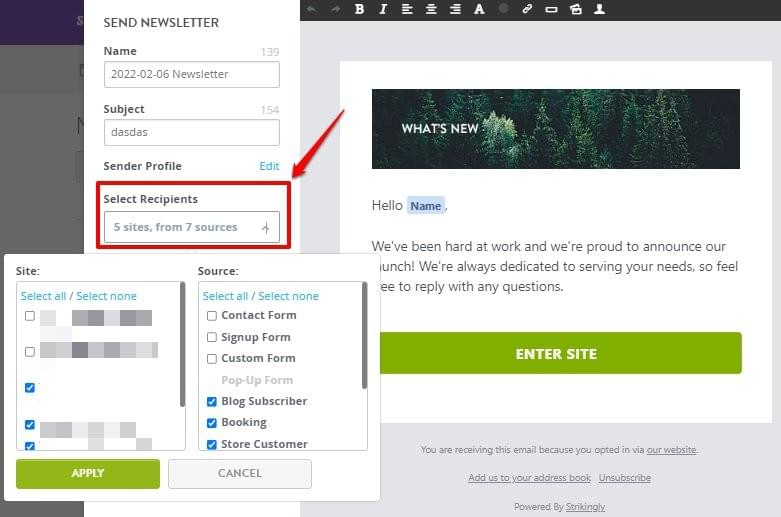
Strikingly Newsletter Sender Profile
Online business branding reaches beyond visible web pages. Creating cohesive digital touchpoints requires checking automated replies, booking confirmations, receipts, newsletters, account notices, and support messages. These moments arrive after trust has been placed, so inconsistency can feel especially careless.
Keep the sender name, subject style, vocabulary, and response expectations recognizable. Strikingly's instructions for newsletters from a custom domain show how sender profiles support branded communication. Its guide to sending newsletters to subscribers covers content, recipient filters, tests, and drafts.
Maintaining consistent brand messaging in operational messages does not require promotional language. A payment confirmation should be precise. A delay notice should be candid. A support reply should be useful. Creating cohesive digital touchpoints means the same values remain visible when the business is explaining a problem, not only when it is making a sale.
Measure recognition and correct drift
Online business branding should be reviewed with evidence. Ask customers what they remembered, expected, and used to choose. Review branded search, direct visits, returning visitors, email engagement, and assisted conversions as directional signals. Creating cohesive digital touchpoints should improve continuity across several of these signals, not merely one dashboard number.
Strengthening customer brand recall can be tested simply. Show a customer or colleague several unlabeled assets for a few seconds, remove them, and ask which belonged together and why. Their reasons reveal whether developing recognizable visual elements produced distinctive cues or only attractive decoration.
Use Strikingly built-in analytics to compare traffic and page activity before and after meaningful brand changes. Measurement should also trace creating cohesive digital touchpoints: do visitors continue from campaign pages, do subscribers return to relevant content, and do repeated actions use the same path?
A monthly brand drift review
Select one customer journey and collect its assets. Check visual rules, message hierarchy, action labels, sender identity, proof, and next-step expectations. Assign mismatches to an owner and fix the highest-risk handoff first. Maintaining consistent brand messaging improves faster when teams review customer paths instead of isolated designs.
Reviewing online business branding does not mean freezing it. Customer needs change and offers mature. Maintaining consistent brand messaging during updates requires documenting what changes, where it applies, and which familiar cues remain. That discipline protects strengthening customer brand recall while allowing the identity to grow.
Make the next encounter easier to recognize
Developing recognizable visual elements gives customers signals they can identify quickly. Maintaining consistent brand messaging gives those signals a stable meaning. Creating cohesive digital touchpoints carries that meaning across real journeys, and strengthening customer brand recall makes a future encounter feel familiar.
Choose one important customer route this week. Compare every screen and message, remove one contradiction, standardize one repeated action, and preserve one distinctive cue. Online business branding becomes valuable when recognition reduces effort and helps people understand that the same dependable business is still guiding them.
