Let Website Content Performance Guide Your Next Update
Let Website Content Performance Guide Your Next Update

Do not manage a content library by age alone. An older guide may still attract qualified readers while a new article creates no useful movement. Website content performance gives each page a job: keep, expand, repair, or retire.
The work combines four decisions. Identifying pages with strong engagement reveals patterns worth protecting. Refreshing content with declining traffic recovers useful assets. Comparing conversion rates across topics shows which subjects support action, and prioritizing high-value content updates directs limited editorial time.
Sort every page into one working folder
- Grow: Strong audience response and strong business value justify expansion.
- Maintain: Stable, useful pages need accuracy checks rather than a rewrite.
- Repair: A meaningful page has lost traffic, engagement, or conversion momentum.
- Exit: The page has no distinct audience, current purpose, useful links, or credible recovery path.
This portfolio view prevents website content performance from becoming a leaderboard of pageviews. It also matches the keep, update, merge, redirect, or remove logic in Strikingly's practical website content audit. Each page receives an action because of evidence and purpose, not because someone dislikes the wording.
Define success before reading the dashboard
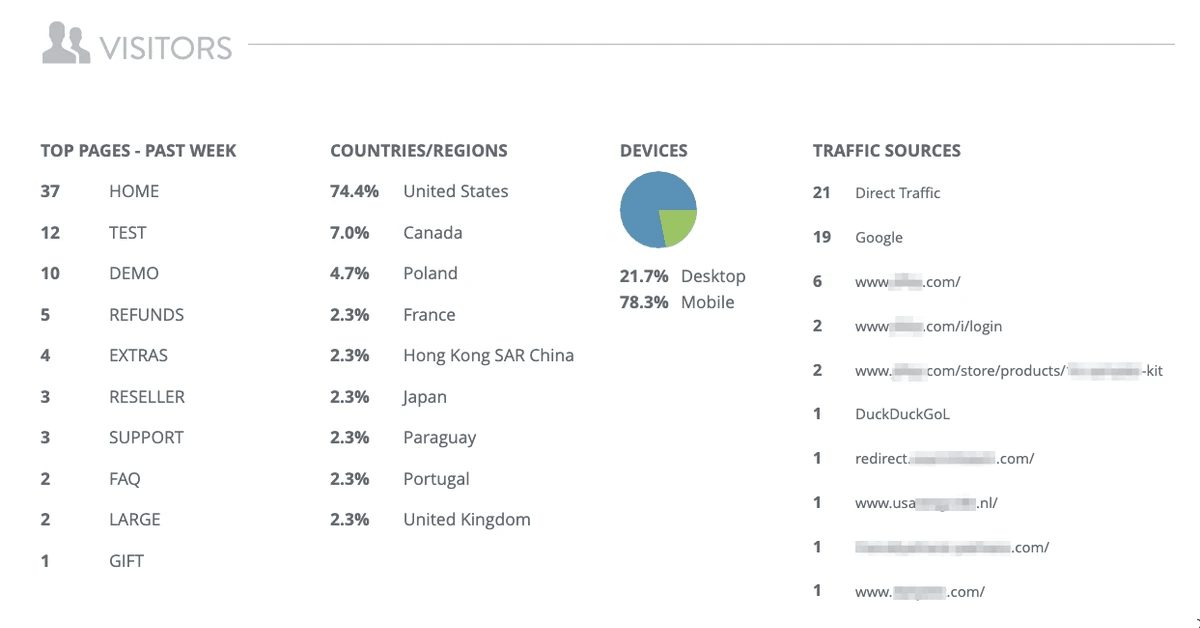
Strikingly Unique Visitors Dashboard
Begin with page type and visitor intent. An educational article may succeed through engaged reading and clicks to a related guide. A service page may succeed through proof views and inquiries. A product comparison may succeed through product-page continuations. Identifying pages with strong engagement requires a definition of useful progress for each type.
Use a consistent review period and compare like with like. Identifying pages with strong engagement by mixing a seasonal campaign page with an evergreen guide creates a false ranking. Segment by page type, traffic source, device, and new versus returning visitors where volume allows. The Strikingly article on website engagement metrics explains why behavior only becomes meaningful when connected to what the visitor did next.
A website content performance baseline should record the page job, audience, period, and primary action. This keeps identifying pages with strong engagement focused on behavior that supports the page's purpose.
Strikingly's built-in analytics provides a practical starting point for visits, pages, sources, devices, and other site patterns. Connect Google Analytics 4 when you need deeper events and segments. Website content performance should use stable definitions across both systems rather than forcing their totals to match exactly.
Use identifying pages with strong engagement to protect proven signals

Perspective Blog Template from Strikingly
Identifying pages with strong engagement starts with combinations, not one high number. Look for several signals moving together: sustained relevant visits, meaningful reading, related-page clicks, return visits, qualified inquiries, purchases, downloads, or fewer support questions. Long time on page can mean interest, but it can also mean confusion. A quick service-page visit can be successful if the phone number was the goal.
When identifying pages with strong engagement, read the page after reading the data. Note what the introduction promises, which examples make the topic concrete, where internal links appear, and how the action follows the explanation. Strong pages often reveal reusable editorial patterns. They do not justify copying entire layouts across unrelated topics.
Protect working elements during an update. Identifying pages with strong engagement should lead to a short preservation note listing the page promise, valuable sections, important links, ranking themes, and conversion path. Website content performance can decline after an unnecessary full rewrite because the new version removes the very context readers valued.
Use strong pages as research sources for adjacent questions. If a guide about implementation earns engaged visits and qualified continuations, expand the topic with a checklist, example, or advanced decision page. The Strikingly guide to website content strategy connects audits, audience needs, gaps, and future planning instead of treating each article as an isolated publication.
Begin refreshing content with declining traffic with a diagnosis

Strikingly Drag and Drop Feature
Refreshing content with declining traffic begins by confirming that the decline is real. Compare equal periods, align weekdays, account for seasonality, and annotate promotions, outages, redesigns, tracking changes, and search demand. One weak week is not a trend. Refreshing content with declining traffic is justified when a sustained decline appears across impressions, visits, and useful next actions. Website content performance needs this baseline to separate noise from a repair signal.
Separate discovery loss from experience loss. If impressions fall, refreshing content with declining traffic may require better topical coverage, fresher evidence, or a closer match to current search intent. If impressions remain stable but clicks fall, review the title and description. If visits remain stable but engagement drops, inspect the opening, page structure, speed, links, and next step. This distinction keeps refreshing content with declining traffic tied to a visible cause.
Do not erase a page's history in the name of freshness. Refreshing content with declining traffic should preserve accurate explanations and earned links while correcting obsolete facts, weak examples, broken references, and missing questions. Strikingly's article on refreshing strong pages without starting over emphasizes choosing a route before editing.
Make the smallest change that addresses the diagnosis. Refreshing content with declining traffic may mean replacing one outdated section, adding a current example, merging overlap, improving headings, or repairing internal links. The Strikingly Help Center's guidance for optimizing blog posts for search engines reinforces useful, relevant, readable, semantically complete content rather than superficial keyword additions.
Start comparing conversion rates across topics without rewarding easy actions

Fresh Blog Template from Strikingly
Comparing conversion rates across topics requires the same conversion definition, audience stage, and date range. A pricing article may naturally create more inquiries than an early educational guide. That does not make the guide worthless. It may introduce qualified visitors who return later through search, email, or a direct visit.
Group topics by the decision they support: discovery, problem understanding, comparison, purchase, implementation, or retention. Comparing conversion rates across topics inside these groups is more credible than comparing every post with one site average. Use both direct conversions and assisted movement to the next relevant page. Apply one attribution rule when comparing conversion rates across topics so credit does not shift between reports.
When comparing conversion rates across topics, show the denominator. Using two inquiries from 20 visits and 40 from 400 visits produces the same rate but different confidence. Small samples should trigger observation, not a major editorial shift. Website content performance becomes more reliable when reports show volume beside percentage.
Check lead quality as well as form completion. Comparing conversion rates across topics can reveal that one theme produces many weak inquiries while another produces fewer, better-fit opportunities. Website content performance should report that quality difference beside the rate. The Strikingly article on website performance analysis recommends matching metrics to each page's job and turning patterns into reviewable actions.
Use prioritizing high-value content updates to fund the strongest case

Strikingly Styles Feature
Prioritizing high-value content updates means combining potential, urgency, effort, and risk. Start with pages that have a clear audience, meaningful visibility, business relevance, and a fixable weakness. A high-traffic page promoting an outdated offer deserves immediate attention. A low-traffic page answering an important sales question may also deserve protection.
Use a simple scoring conversation rather than pretending every input is precise. For prioritizing high-value content updates, rate the page's audience value, business influence, evidence of decline, update effort, and downside if ignored. Document the reasoning in one sentence. This makes the queue understandable when priorities change and keeps website content performance connected to an editorial decision.
A one-page update brief
- State the page's audience, job, and current performance pattern.
- Record what must be preserved and what evidence shows a weakness.
- Name one focused update and the expected visitor benefit.
- Choose a primary metric, a quality guardrail, and a review date.
- Decide in advance what result would justify keeping, revising, or reversing the change.
Prioritizing high-value content updates also means delaying attractive but weakly supported rewrites. If the evidence is unclear, improve measurement first. If two pages overlap, decide whether consolidation would serve readers better. For prioritizing high-value content updates, the risk of confusing an established audience belongs in the score. The Strikingly article on website content optimization is useful here because content changes often affect related pages, links, and search intent together.
When prioritizing high-value content updates, release them in small groups so effects remain readable. Before publication, use Strikingly's pre-publish checklist to review titles, descriptions, links, media, navigation, and mobile presentation. Prioritizing high-value content updates is incomplete until someone owns the release and follow-up review.
Review the portfolio on a rhythm the team can sustain
Run a monthly review for priority pages and a quarterly review for the wider library. Website content performance should compare each page with its own baseline and relevant peers. Identifying pages with strong engagement protects proven value, while refreshing content with declining traffic gives promising pages a controlled recovery path.
During each review, keep comparing conversion rates across topics within similar stages and continue prioritizing high-value content updates with documented evidence. Comparing conversion rates across topics requires recording what changed, when it changed, and what result the team expects. This history prevents the same debate from restarting every month.
Website content performance is useful when it changes editorial behavior. Publish less blindly, preserve more deliberately, diagnose declines before rewriting, and invest where audience value and business value meet. Identifying pages with strong engagement, refreshing content with declining traffic, comparing conversion rates across topics, and prioritizing high-value content updates then become one repeatable management practice rather than four disconnected reports.
