Business Blog Optimization That Makes Every Article Work Harder
Business Blog Optimization That Makes Every Article Work Harder

An older article does not need a complete rewrite simply because traffic has slowed or readers rarely continue to another page. Business blog optimization begins by finding the exact moment where usefulness weakens. The opening may delay the answer, a supporting fact may have expired, or the final invitation may ask for too much. A focused edit can protect the article's earned visibility while making it more valuable now.
Treat the article like a working asset. Improving article introductions earns attention, and adding relevant internal links continues the inquiry. Updating statistics and examples protects credibility, while strengthening calls to action offers a sensible next step. Review these jobs together because a change near the top can alter what readers need at the end.
Put one existing post on the editing table
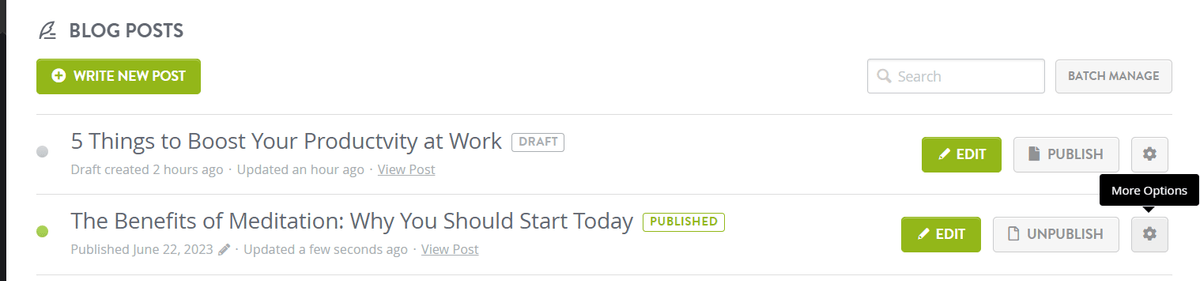
Strikingly Blog Posts Manager
Choose a post that already has a reason to exist: it answers a recurring customer question, attracts search visits, supports a service, or earns useful replies. The Strikingly Blog Posts Manager lets editors find, edit, publish, unpublish, duplicate, and organize posts. Begin business blog optimization with one article rather than opening twenty drafts and losing the thread.
The four-pass diagnosis
- Entry: For improving article introductions, can a new reader identify the problem and promised answer within the first screen?
- Route: When adding relevant internal links, do destinations answer the next questions created by the article?
- Evidence: When updating statistics and examples, can every number, feature, and recommendation still be trusted?
- Action: When strengthening calls to action, does the invitation match what an informed reader is ready to do?
Record current views, engaged reading, useful link clicks, and conversions before editing. Strikingly's built-in analytics identifies top-viewed posts, while the Google Analytics 4 connection supports deeper event analysis. A baseline keeps business blog optimization tied to reader behavior.
Rewrite the first screen around the reader's unfinished job

Strikingly Blog Image Alt Text Editor
Improving article introductions is not the same as making them more dramatic. A useful introduction confirms why the reader arrived, names the consequence of the problem, and previews the help ahead. Delete warm-up history that a reader must cross before reaching the answer. The opening should establish direction without summarizing every section.
Before: "In today's rapidly changing digital world, blogs are more important than ever for every modern business."
After: "If your service article attracts visits but few inquiries, inspect the promise, proof, and next step before publishing another post."
The stronger version identifies a symptom and gives the reader a diagnostic route. For business blog optimization, read the first 150 words without looking at the title. Ask what the article will help someone decide or do. If the answer remains vague, improving article introductions means moving the clearest practical sentence forward, not adding another claim about importance.
Match the promise to the searcher's knowledge. A beginner needs definitions and a small first move; a comparing buyer needs constraints and proof. The Strikingly guide to optimizing blog posts for search engines recommends valuable, readable material instead of keyword stuffing. Improving article introductions follows that principle.
Check the title, opening, and description as one promise. Business blog optimization fails when a lively headline attracts one intent and the article serves another. Improving article introductions succeeds when the first paragraph pays off the expectation created in search results.
Draw the reader's next questions in the margins

Strikingly Text Link Editor
Adding relevant internal links starts after the draft answers its main question. Beside each section, write the reader's likely next question. Pricing may prompt comparison; a checklist may prompt implementation. Link only when another page gives a stronger answer than a detour inside the current post.
Use descriptive anchor text that explains the destination. Strikingly's guide to adding links to text shows how selected words can become a link in the editor. Adding relevant internal links should produce anchors such as "review blog categories" or "measure article engagement," not a trail of identical "read more" prompts.
- Link from a broad guide to a focused procedure when the reader needs execution detail.
- Link from a decision article to proof, policies, or a relevant service page.
- Link back from the supporting page so the topic forms a useful two-way route.
- Remove links to merged, retired, or weaker pages during the same review.
The goal is continuity, not volume. Simple Blog Categories can group posts, and Strikingly Site Search provides another discovery route. Adding relevant internal links still matters because an editorial link carries context that menus cannot.
For business blog optimization, test every link by finishing the sentence before it. Would the destination help at that exact moment? Adding relevant internal links should reduce the effort needed to continue, not send readers backward to a generic homepage. Review the destination too; a strong article connected to a weak page merely moves the credibility problem.
Updating statistics and examples with an expiration rule

Fresh Finest Blog Template from Strikingly
Updating statistics and examples begins with claims most likely to influence a decision: prices, percentages, feature availability, legal requirements, timelines, and performance benchmarks. Highlight every number and named product. Beside each one, record its source, source date, and the date it was checked. If no reliable source survives, replace false precision with a plainly bounded explanation.
Examples age differently from statistics. A customer scenario can remain useful when the behavior is recognizable, while an old interface screenshot may confuse immediately. Updating statistics and examples requires judgment: preserve durable lessons, but label historical context readers could mistake for current practice.
Business blog optimization also asks whether examples represent the audience. Add a small-business case or product decision only when it clarifies advice. Strikingly's article on refreshing existing website content recommends correcting facts and connecting older pages to current guidance. Updating statistics and examples should make the article dependable, not merely newer-looking.
When a refresh changes an image or example, update its nearby explanation and alternative text as well. Updating statistics and examples without revising the conclusion can leave the post arguing from evidence it no longer contains. Business blog optimization works best when evidence, interpretation, and recommendation are reviewed together.
Strengthening calls to action as a natural continuation
Strengthening calls to action starts with the article's delivered value. After a diagnostic post, offer a worksheet or assessment. After a detailed tutorial, point to an advanced guide or relevant tool. After a decision article, invite a consultation or product comparison. A CTA should feel like the next chapter of the same task, not an unrelated sales interruption.
Replace vague button copy with an action and outcome. "Submit" describes the interface; "Request a content review" describes the reader's move. The Strikingly guide to call-to-action placement recommends clear actions at meaningful points in the page. Strengthening calls to action also means stating what happens next, especially when a form requests business information.
Reduce commitment for early research. Strikingly supports blog email subscriptions and newsletters for readers seeking future guidance. A qualified prospect may be ready for a focused custom form. Strengthening calls to action means matching the invitation to intent.
Use one primary action and one quieter alternative when needed. Business blog optimization should remove competing banners and repeated buttons. Strengthening calls to action is often subtraction: a specific promise, visible placement, reasonable request, and honest expectation can outperform several urgent demands.
Publish a revision record, then watch what changes
Finish with an internal record: revised promise, links changed, evidence checked, CTA changed, publication date, and reviewer. This turns business blog optimization into a repeatable practice and prevents the next editor from rediscovering why an example or destination was retained.
Measure the edited post over a comparable period. Improving article introductions may change engaged reading or early exits. Adding relevant internal links may increase movement to deeper resources. Updating statistics and examples may not create an immediate dashboard spike, but it can improve sales conversations, citations, and reader trust. Strengthening calls to action should be judged by qualified completions, not clicks alone.
Give the article enough exposure, compare like-for-like traffic, and collect direct feedback. Business blog optimization becomes reliable when a team connects a revision to an observed result. Strikingly's guide to website content optimization also shows why page relationships and search intent matter beyond one URL.
- Choose one proven or strategically important post and preserve its strongest material.
- Complete improving article introductions, adding relevant internal links, updating statistics and examples, and strengthening calls to action in that order.
- Preview links, mobile reading, forms, descriptions, and visual references before publishing.
- Record the revision and review meaningful behavior after enough traffic arrives.
On the next review cycle, return to the evidence instead of automatically rewriting. Improving article introductions may need a clearer audience cue, while adding relevant internal links may require a new destination created since the last edit. Updating statistics and examples may reveal that a once-useful claim should be removed. Strengthening calls to action may simply require a better expectation beside the existing form.
Good business blog optimization is careful maintenance with a commercial purpose. It respects what an article has already earned while improving what readers experience today. When improving article introductions, adding relevant internal links, updating statistics and examples, and strengthening calls to action all serve the same reader task, an older post can become more useful without pretending it was written from scratch.
