An Ecommerce Retention Strategy That Begins After Checkout
An Ecommerce Retention Strategy That Begins After Checkout

A first order creates evidence: the customer trusted the store, chose a product, and accepted the price. An ecommerce retention strategy should use that context to make the next experience more useful. It should not immediately turn a completed sale into a stream of generic discounts. The better sequence confirms the decision, helps the customer succeed, notices the next likely need, and then makes returning easy.
This approach connects encouraging second purchases with the experience between orders. Creating product follow-up campaigns gives each message a purpose. Highlighting complementary products reduces the work of finding what fits. Building customer loyalty through useful offers rewards a meaningful next step instead of training people to wait for a coupon.
The post-purchase clock
- Immediately: Confirm the order, delivery expectations, support route, and any action the customer must take.
- After arrival: Help the customer reach a first useful result with setup, care, or usage guidance.
- After initial use: Recommend an accessory, refill, upgrade, or related item only when it extends that result.
- Near the next need: Send a reminder or offer based on a realistic replacement, replenishment, or seasonal cycle.
- After the return: Recognize the relationship and measure whether the second experience was easier than the first.
Timing differs by product, but an ecommerce retention strategy follows use rather than an arbitrary email calendar. That keeps encouraging second purchases from feeling like repeated pressure.
Make the first follow-up reduce uncertainty
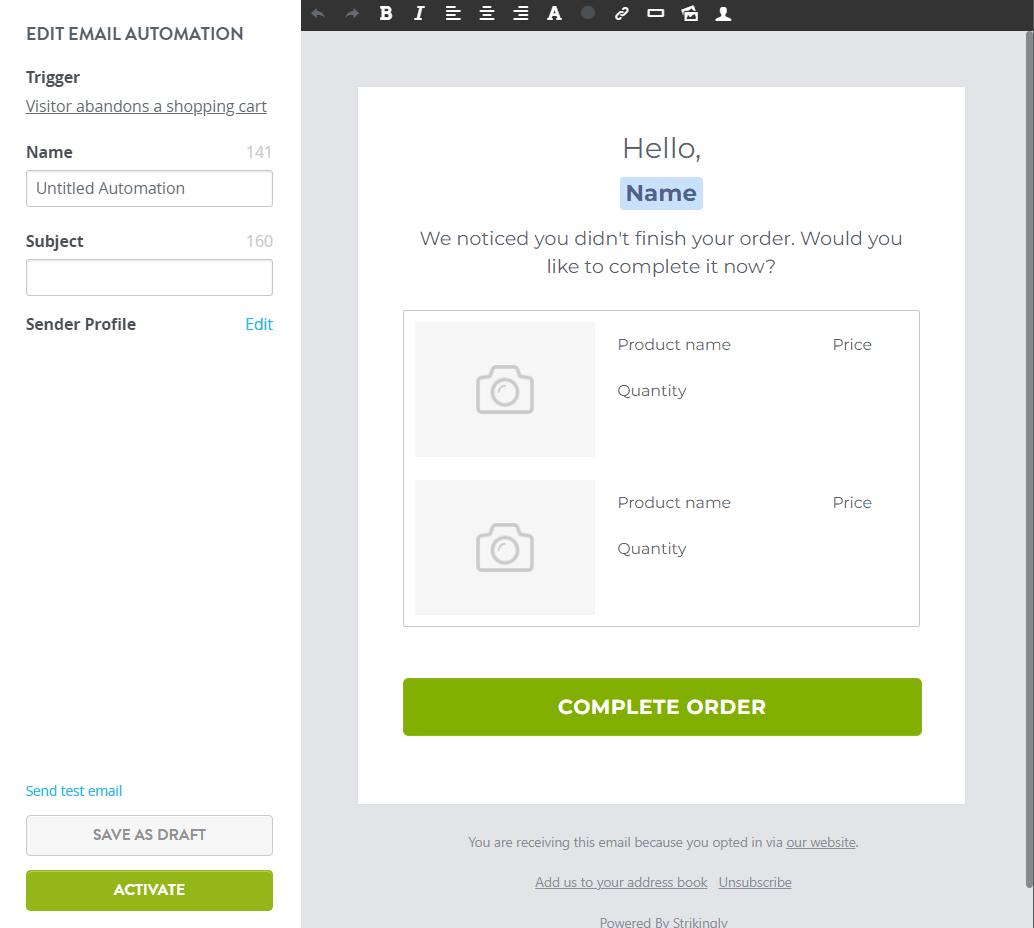
Strikingly Automated Email Editor
The first message after checkout should settle practical questions. Restate what was purchased, explain fulfillment timing, link to order support, and clarify what the customer should expect next. The Simple Store FAQs help store owners understand the underlying order flow, while the Simple Store setup guide covers the storefront foundation. A dependable foundation matters because creating product follow-up campaigns cannot repair vague fulfillment.
Once the package arrives, the message should change from transaction status to customer progress. Give one useful instruction, not a catalogue of every possible resource. A care note, a two-minute setup guide, or a troubleshooting link can protect the initial decision. Building customer loyalty through useful offers begins here, even when the “offer” is simply timely expertise that prevents avoidable disappointment.
Strikingly's automated email feature supports purchase-based triggers and delayed delivery. For creating product follow-up campaigns, map each delay to anticipated delivery, first use, likely depletion, or seasonal change. Creating product follow-up campaigns means a three-day delay exists because day three is useful, not because it was the default.
Use the first success to shape the next recommendation

MysteryBox Template from Strikingly
Ask what successful use looks like before recommending more. For a camera, it may be the first sharp photo; for a meal kit, the first served recipe; for skincare, a routine without irritation. An ecommerce retention strategy should protect that success before requesting another transaction.
This is where highlighting complementary products becomes helpful rather than intrusive. Highlighting complementary products should answer “What helps me get more from what I already own?” A memory card supports a camera, replacement blades support a tool, and refill paper supports a craft kit. The Strikingly product-bundling guide recommends using purchase behavior and customer needs. An ecommerce retention strategy needs that evidence instead of bestsellers beside every product.
Create a short relationship statement for each recommendation: “Use this with X when you want Y.” Highlighting complementary products with that sentence explains compatibility, timing, and benefit. It also helps encouraging second purchases because customers can judge relevance without reopening several product pages.
Build recommendations around jobs, not labels

CraftBox Ecommerce Website Template from Strikingly
Highlighting complementary products by customer job might create sets such as “protect your purchase,” “complete the setup,” “make travel easier,” or “refill your routine.” Strikingly's product management guidance explains available product details, and product categorization can group related options for easier browsing.
Review actual order pairs and support questions before creating a bundle. If buyers repeatedly ask whether two items work together, clarify compatibility on both pages. If they commonly buy the pair weeks apart, create the route between them. An ecommerce retention strategy gets stronger when highlighting complementary products reflects observed behavior rather than merchandising instinct alone.
Choose a second-purchase moment the customer can recognize
Encouraging second purchases works best when the reason is visible. A consumable may be running low, a seasonal item may become useful again, or a beginner product may have prepared someone for an advanced version.
Estimate the earliest reasonable return window from product quantity and normal usage. Then compare that estimate with actual order intervals. An ecommerce retention strategy can start with a hypothesis, but it should become more precise as evidence accumulates. If most customers reorder after forty-five days, a discount on day seven is mistimed and may reduce margin without changing behavior.
Creating product follow-up campaigns around this window allows messages to do different jobs. The first can teach use, the second can surface a related resource, and the third can make a relevant return path visible. Encouraging second purchases does not require each message to ask for an order. A useful sequence earns attention before it spends attention on a promotion.
Segment by the purchased product whenever the catalogue is varied. The Audience contact manager keeps customer information accessible, while Audience emails support targeted communication. Creating product follow-up campaigns for a specific ownership context is more credible than sending the same “We miss you” message to everyone.
Make offers useful before making them urgent
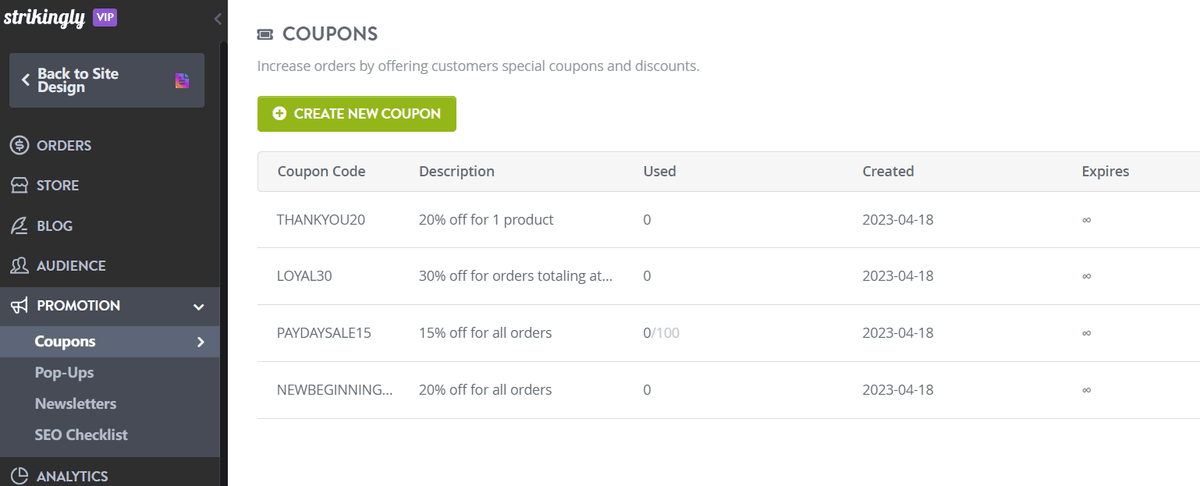
Strikingly Coupon Manager
Building customer loyalty through useful offers means deciding what the customer gains besides a lower price. A refill bundle may save time, early access may secure limited inventory, member content may improve product use, and free shipping may remove replenishment friction. Building customer loyalty through useful offers requires that value to match a known barrier.
Strikingly's guide to coupons for returning customers combines store coupons with member access. Use that capability selectively. Building customer loyalty through useful offers is weakened when every order produces an immediate percentage discount, because customers learn that the listed price is temporary. Reserve incentives for a clear behavior, milestone, or segment.
For example, encouraging second purchases for a replenishable product may justify free shipping near the reorder date. Highlighting complementary products may justify a modest bundle saving when the set removes a task. Building customer loyalty through useful offers may also mean giving repeat buyers a guide, sample, or priority service. Building customer loyalty through useful offers can protect margin when the benefit solves a genuine problem.
Building customer loyalty through useful offers can include membership when it provides order history, private resources, or appropriate benefits. The Strikingly membership guide explains purchase-based registration, member-only pages, and account access. Membership should simplify the relationship, not add a login merely to hide ordinary information.
Measure the distance between value and return
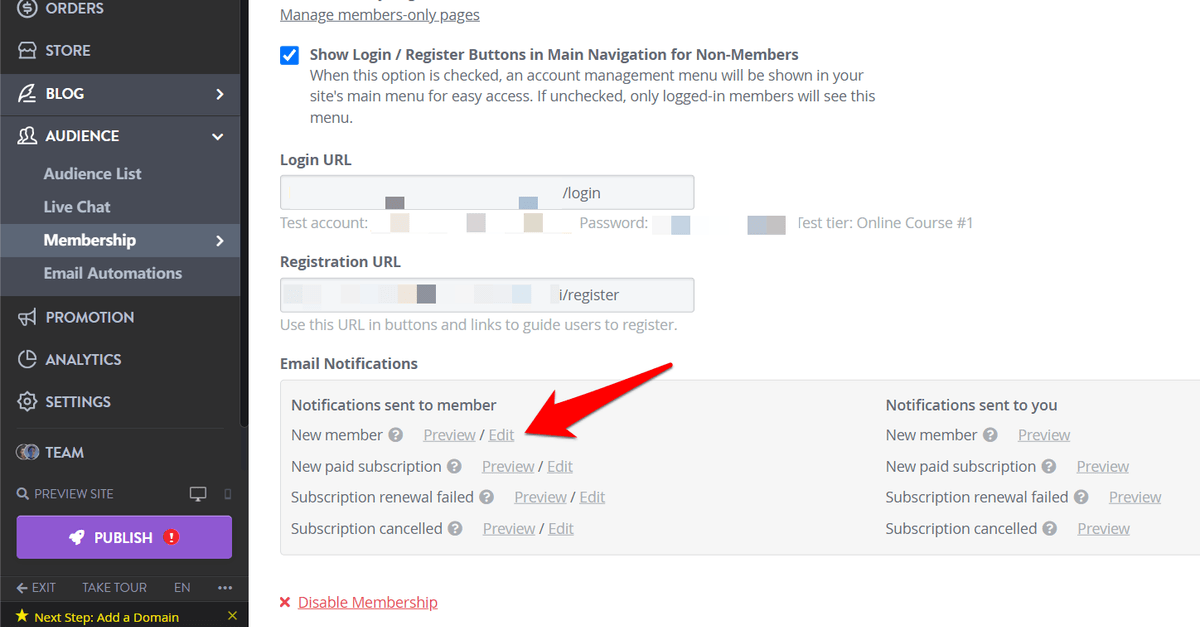
Strikingly Membership Email Notifications
Measurement for encouraging second purchases begins with customer outcomes, not email volume. Track second-purchase rate, median days to the second order, repeat revenue, offer redemption, unsubscribe rate, and product-specific return patterns. Encouraging second purchases should improve customer economics without creating excessive incentives or complaints. Building customer loyalty through useful offers should show healthier repeat behavior, not only a spike during a sale.
Use Strikingly's built-in analytics to review traffic and page activity, then connect the site to Google Analytics 4 when the journey needs deeper event analysis. For creating product follow-up campaigns, tag each destination and compare cohorts by first product, message, timing, and offer.
Read qualitative evidence alongside the numbers. Product reviews, support questions, returns, and direct replies can reveal whether highlighting complementary products made a choice easier or introduced confusion. An ecommerce retention strategy needs this context because a fast repeat purchase followed by a return is not a durable win.
A monthly retention review
- Compare expected and actual time to the second order for each major product family.
- Review whether creating product follow-up campaigns improved setup, product use, or support outcomes.
- Check whether highlighting complementary products increased relevant pairings without increasing returns.
- Separate encouraging second purchases caused by natural need from purchases caused mainly by deep discounts.
- Evaluate whether building customer loyalty through useful offers improved repeat margin and customer response quality.
Treat the ecommerce retention strategy as a learning loop in which timing, relevance, and customer value improve together. Choose one change after each review: adjust a delay, replace an irrelevant recommendation, clarify a compatibility note, or narrow an offer. Creating product follow-up campaigns becomes manageable when each cycle answers one question. Highlighting complementary products also becomes more accurate when weak pairings are removed instead of endlessly expanded.
Let the next order feel like continued progress
A durable ecommerce retention strategy treats the period after checkout as part of the product experience. Encouraging second purchases then becomes the result of successful ownership, relevant timing, and an easy return path. Creating product follow-up campaigns gives the store a way to deliver those elements in sequence without repeating the same sales request.
Start with one high-volume product. Define its first success, likely next need, strongest companion item, and reasonable return window. Use that map for highlighting complementary products and building customer loyalty through useful offers. Once the sequence works for customers and for margin, adapt it to the next product family. That is how encouraging second purchases becomes a repeatable system rather than a recurring promotion.
